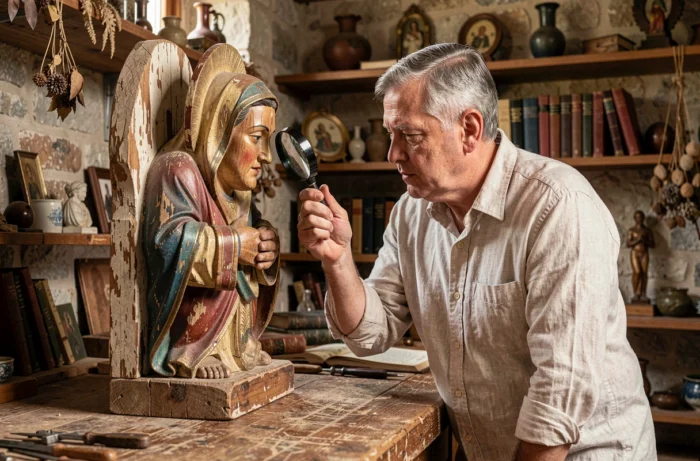
Hagietomamophilia refers to a specific attraction to religious wooden statues, distinct from agalmatophilia, which encompasses statues of all kinds. The term, formed from the Greek roots hagios (sacred), toma (cut, section) and philia (love), applies exclusively to devotional sculptures carved from wood. This material and symbolic specificity makes it a subject of study in its own right, at the intersection of the history of sacred art, religious anthropology and heritage conservation.
Polychromy and material: what sacred wood reveals beneath the paint layer
Religious wooden sculptures are more than their three-dimensional form. Their surfaces almost always bear historic polychromy, sometimes covered by several successive layers accumulated over the centuries. Restoration work on these pieces often aims to recover their original polychromy, radically changing how the statue is perceived, both visually and emotionally.
The choice of wood (oak, limewood, walnut, poplar) directly affects the level of detail that can be carved and the object’s durability. A limewood Madonna and Child allows for drapery work that would be stiffer in oak. These technical distinctions fuel the fascination with hagietomamophilia among collectors and historians of sacred heritage.
The conservation of these sculptures depends on stable environmental conditions, particularly in terms of relative humidity and temperature. Sudden fluctuations cause cracks, lifting paint layers and structural deformation. Wood-boring insects (woodworm and longhorn beetles) pose a constant threat in poorly ventilated religious buildings.
The sacred status of wooden statues: devotion, access and institutional protection
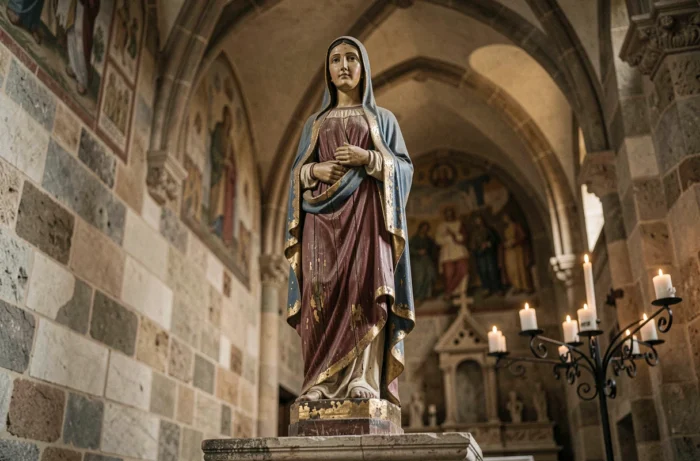
A religious wooden statue is not just another work of art. Its sacred status shapes how worshippers, visitors and institutions interact with it. In the Catholic tradition, the practice of dressing statues in fabric garments, documented since the late Middle Ages, illustrates the enduring tension between tactile devotion and material preservation.
Art historians long condemned this practice because it conceals the sculpture. Some religious figures also rejected it, seeing it either as a form of idolatry or as a profane act; dressing and adorning Marian statues was sometimes considered indecent. In the late 19th century, many statues were stripped of their garments or discarded under this combined pressure.
Municipalities are often responsible for conserving statues in places of worship, but the resources allocated vary widely. This creates a paradox: the sacred object falls under the responsibility of the public community, while its liturgical use depends on the religious body responsible for the building.
Processions and handling: devotional practices and physical risks
Wooden sculptures used in processions are subject to mechanical stresses that museum pieces do not experience. Carrying, vibrations and accidental knocks weaken joints and accelerate the deterioration of the polychromy. Some dioceses now regulate these practices with handling protocols.
- Statues should be carried by the base, not by projecting elements (hands, attributes, crozier), to avoid irreversible fractures
- Undyed cotton gloves are recommended to prevent skin acidity from transferring to polychrome surfaces
- Between processions, statues must be stored in a space with controlled humidity, away from direct heat sources
These requirements show that the physical relationship between worshippers and statues remains a practical concern, not merely a symbolic one.
Hagietomamophilia and agalmatophilia: a distinction worth making
Agalmatophilia, a term attested in the literature, refers to an attraction to statues in general, regardless of material or context. It is among the documented paraphilias. Hagietomamophilia differs in two respects: the material (wood) and the sacred nature of the representation.
This distinction is not trivial. The object of attraction is not the abstract sculptural form, but the devotional significance the work has accumulated over the centuries. A polychrome Romanesque wooden Madonna in a rural chapel does not have the same effect as a 19th-century plaster copy.
We find that the available scientific literature does not yet recognize hagietomamophilia as an established clinical term. It should be treated as a descriptive neologism, useful for naming an observable phenomenon, without inferring a medical diagnosis.
Religious wooden sculptures in museums: aesthetic appreciation versus liturgical function
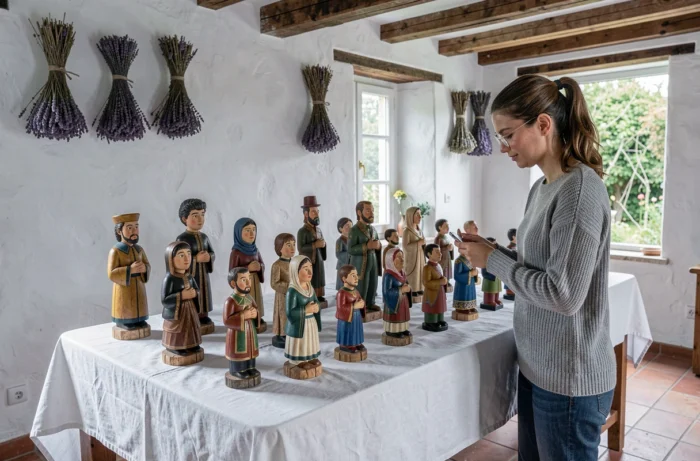
Moving a devotional sculpture from a place of worship to a museum profoundly changes how it is received. The object loses its liturgical function and becomes a work of art. This shift neutralizes the sacred dimension that underpins the specific appeal of hagietomamophilia.
Museums enforce strict access rules: climate-controlled display cases, low-UV lighting and no touching. These measures protect the work but eliminate the tactile relationship that characterizes traditional devotional practice. The worshipper who once placed a hand on the statue to receive a blessing becomes a visitor kept at a distance.
Cataloguing and heritage designation
The systematic cataloguing of wooden sculptures in French churches remains a long-term undertaking. Many pieces, particularly in rural areas, have never been catalogued. Theft and damage can therefore go unnoticed in the absence of prior photographic and descriptive records.
- Photographic inventories are the first line of defense against theft: an identified sculpture is difficult to resell on the art market
- Records should include dimensions, wood type, the condition of the polychromy and tool marks
- Cooperation between municipalities, church councils and departmental heritage services speeds up the identification of works at risk
Whether driven by devotion, heritage curiosity or a more personal fascination, interest in religious wooden statues always encounters the object’s fragile material nature. Wood ages, cracks and attracts insects. Protecting these works requires balancing public access, liturgical use and rigorous conservation—three priorities that rarely align.