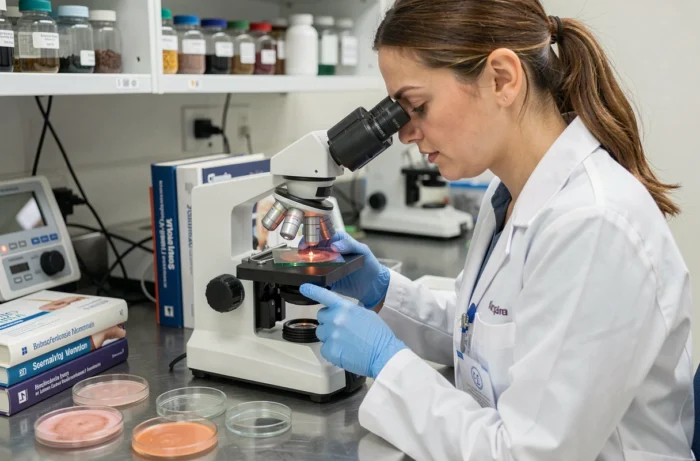
Dandruff that keeps coming back despite shampooing, a scalp that itches for no apparent reason: in most cases, a microscopic yeast called Malassezia restricta is present in the affected area.
Yet this yeast lives on the skin of almost all adults, including those with no symptoms. Recent research shows that its mere presence is not enough to explain skin problems. Malassezia-related skin conditions are more a matter of an imbalance in the skin ecosystem than a conventional infection.
Malassezia restricta on a healthy scalp: why its presence is normal
Have you ever noticed that two people using the same shampoo can get very different results? Part of the explanation lies in the skin microbiome—the community of microorganisms that live on the skin.
Malassezia restricta is part of this microbiome. It is a lipophilic yeast, meaning it feeds on the fats in sebum. It is found in abundance on the scalp, face, and upper torso, where sebaceous glands are most active.
One point that is often misunderstood: M. restricta is abundant on perfectly healthy scalps. Its presence does not mean there is a disease. To learn more about Malassezia in humans and Malassezia restricta, it is important to first accept this coexistence as a normal state of the skin.
The yeast also coexists with bacteria (Cutibacterium, Staphylococcus) in a dynamic balance. When this balance holds, the skin stays calm. When it is disrupted, symptoms appear.
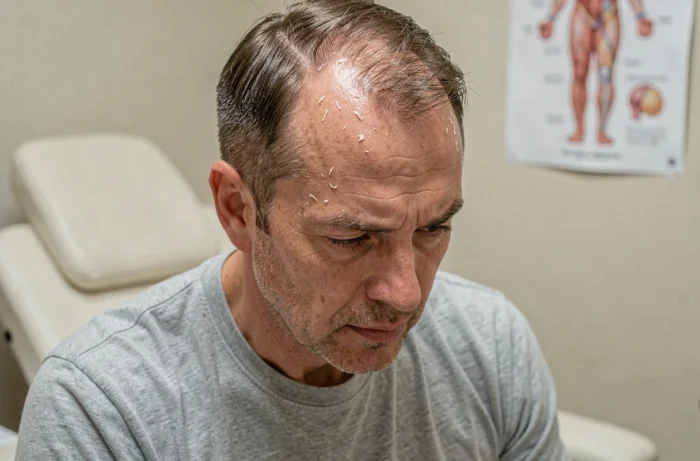
Skin microbiome imbalance and seborrheic dermatitis: what triggers the symptoms
If the yeast is present in everyone, why do some people develop dandruff or seborrheic dermatitis? The answer is not the amount of Malassezia, but how the local immune system responds.
An inappropriate inflammatory response
In patients with seborrheic dermatitis, the skin mounts an exaggerated inflammatory response to Malassezia. Specifically, immune cells release excessive amounts of pro-inflammatory molecules. The result: redness, scaling, and itching.
The problem is not the yeast itself, but the skin’s response. Two people with the same density of M. restricta can have opposite reactions.
A disrupted ecosystem, not simply an excess of fungi
A 2025 study of an anti-seborrheic shampoo tracked changes in the scalp microbiome over the course of treatment. Clinical improvement was accompanied by changes in the relative proportions of fungi and bacteria. Seborrheic dermatitis is better understood as an imbalance in the microbial community than as the overgrowth of a single species.
Several factors can contribute to this imbalance:
- Excessive sebum production, which provides more nutrients for M. restricta and changes the living conditions of neighboring bacteria
- Stress, fatigue, or certain medications, which can alter the local immune response
- Harsh or unsuitable hair care products that disrupt the skin’s surface hydrolipidic film
Normal colonization or pathological imbalance: how to tell the difference in practice
Here is a question many patients ask their dermatologist: how can I tell whether my Malassezia is “normal” or causing my symptoms? In practice, the answer is still complex.
Available tests
Seborrheic dermatitis and pityriasis versicolor are diagnosed primarily through a clinical examination. The dermatologist looks at the location, appearance, and progression of the lesions. For pityriasis versicolor, a Wood’s lamp (ultraviolet light) may reveal characteristic fluorescence.
No routine test measures the Malassezia-to-bacteria ratio on a patient’s skin during a consultation. Skin microbiome sequencing is used in research, but not in routine clinical practice.
What the dermatologist actually assesses
Without a tool to directly measure microbial imbalance, the clinician relies on indirect indicators:
- Response to antifungal treatment: if ketoconazole or selenium sulfide shampoo improves symptoms, this indirectly confirms Malassezia’s involvement
- Chronicity and location of the lesions: seborrheic areas (scalp, sides of the nose, eyebrows) point to seborrheic dermatitis
- Ruling out other conditions: psoriasis, atopic dermatitis, or contact eczema can cause similar symptoms
A randomized trial published in 2024 in Skin Appendage Disorders compared 1% selenium sulfide shampoo with 2% ketoconazole shampoo in patients with moderate to severe seborrheic dermatitis. Both groups improved, showing that clinical improvement cannot identify a specific Malassezia species.
Recent treatment approaches: modulating the microbiome rather than eradicating it
Conventional treatments for Malassezia-related skin conditions aim to reduce the fungal population. Antifungal shampoos and azole-based creams can work, but symptoms often return when treatment is stopped.
A different approach is emerging. A study published in Scientific Reports in 2024 evaluated a probiotic-enriched suspension designed to modulate both the mycobiome (fungi) and the bacteriome (bacteria) in patients with seborrheic dermatitis. The idea is to restore the overall microbial balance rather than target Malassezia alone.
This approach is still exploratory. It does not replace antifungals, whose effectiveness is well documented. Preclinical studies have also tested biological strategies that specifically target M. restricta (including a hydrogel), but the published results are from animal models, not patients.
Antifungal shampoo remains the standard treatment, combined if needed with a topical corticosteroid during acute inflammatory flare-ups. Skin probiotics are a potential future option, not a validated alternative at this time.
The next time dandruff returns despite following treatment carefully, the next step to discuss with a dermatologist may not necessarily be a stronger antifungal. The entire skin ecosystem may need attention—not just the yeast that has always lived there.