
Waxed paper is one of the most common types of food packaging in restaurants, butcher shops and delicatessens, and takeaway businesses. Its waxed surface provides a barrier against moisture and grease, setting it apart from other food papers such as kraft paper or baking paper. Choosing the right waxed paper depends on specific factors: the type of food, serving temperature, contact time and applicable regulations.
Temperature limits of waxed paper: a frequently overlooked factor
Most guides to food papers describe waxed paper as a versatile product. The reality is more nuanced when temperature comes into play.
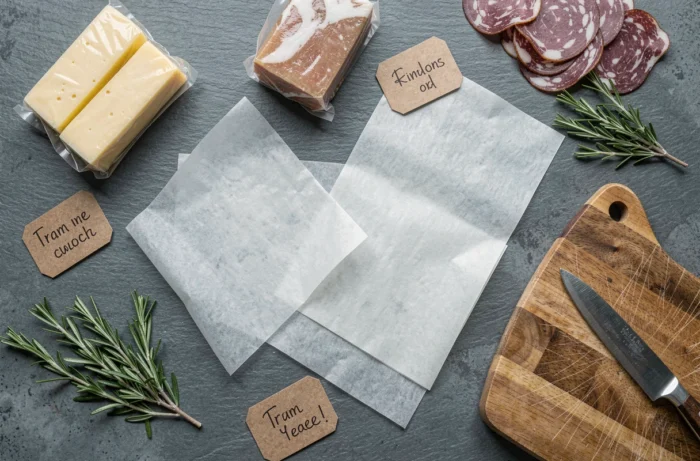
Waxed paper cannot withstand high temperatures. The paraffin coating melts when exposed to excessive heat, making the paper unsuitable for direct contact with a dish fresh from the oven or piping-hot food. Waxed paper is suitable for cold or lukewarm foods, such as cheese, cold cuts, sandwiches and pastries served at room temperature.
Confusing waxed paper with baking paper is a common mistake. Baking paper is treated with silicone to withstand oven heat. Waxed paper, by contrast, is designed to protect, wrap and present food without heating it. Using waxed paper for cooking can release wax into the food and affect its taste.
If your business needs to wrap both hot dishes and cold products, you should use two different types of paper. Waxed food paper for your dishes will cover cold and lukewarm foods for display or takeaway when no reheating is involved.
Food contact and compliance: what the word “suitable” doesn’t tell you
The words “suitable for food contact” on a roll of waxed paper are not a universal guarantee. The DGCCRF notes that the assessment must take three factors into account: temperature, contact time and the type of food (fatty, acidic or moist).
Paper declared compliant for wrapping a sandwich for an hour is not necessarily suitable for storing fatty cheese for several days. Fats can migrate into the paper and, in turn, extract compounds from the paraffin if the conditions of use exceed those specified by the manufacturer.
What to check with your supplier
- The stated conditions of use: compatible food types, temperature range and recommended maximum contact time
- Compliance of the finished product, not just the paraffin itself: the paper or cardboard substrate, any inks and the wax must be assessed together
- Product traceability: a reputable supplier will provide a written declaration of compliance, not just a symbol on the packaging
Under US regulations (Title 21 of the Code of Federal Regulations), synthetic paraffin used in food-contact articles is subject to specific conditions of use. The same principle applies in Europe: every component of the paper must be assessed for its intended use.
Waxed paper, greaseproof paper, kraft paper: which paper for which food?
Waxed paper is just one of several types of food paper. The right choice depends on what you are wrapping and how the product will be eaten.
Greaseproof paper resists fats without a wax coating. It is suitable for pastries, doughnuts and portions of fries. Its surface does not melt when heated, making it more versatile than waxed paper for lukewarm or slightly hot foods.
Kraft paper offers greater mechanical strength. It is used for outer packaging, carrier bags and cushioning. However, without additional treatment, it does not protect against moisture or grease.
Waxed paper sits between the two: it provides a moisture barrier, offers moderate grease resistance and has a smooth surface that makes food easy to present. For butcher shops, delicatessens and cheese shops, where products are cold and fatty, waxed paper remains the most suitable choice.
Quick comparison table
| Feature | Waxed paper | Greaseproof paper | Kraft paper |
|---|---|---|---|
| Grease resistance | Good | Very good | Low |
| Moisture resistance | Good | Moderate | Low |
| Use with hot foods | No | Moderate | No (unless treated) |
| Display case presentation | Very suitable | Suitable | Not very suitable |
| Transport packaging | Not very suitable | Not very suitable | Very suitable |
Choose the weight and format to suit your business
The weight of waxed paper affects its strength and how easily it folds. Paper that is too thin can tear when it comes into contact with a moist or heavy product. Paper that is too thick is harder to fold around small items such as portions of cheese or slices of pâté.
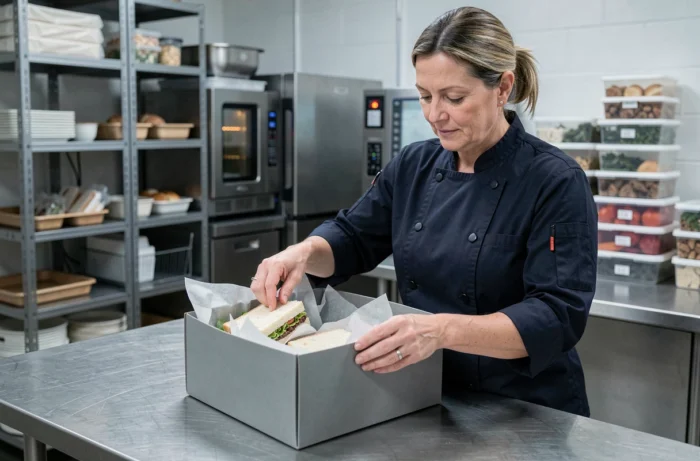
For retail sales in butcher shops or cheese shops, a medium-weight paper offers the best balance of ease of handling and strength. In fast food, where the paper is mainly used as a separator between the food and its container, a lighter weight is sufficient.
Format matters too. Pre-cut sheets reduce handling time during busy service. Rolls can be cut to size, helping to limit waste when products vary in size. The choice between the two depends on service volume and portion consistency.
Shelf life and storage of waxed paper
Waxed paper stored in poor conditions loses its barrier properties. Prolonged exposure to heat softens the wax coating. Ambient humidity can cause sheets to curl and reduce their effectiveness against grease transfer.
Store the paper away from direct light and all sources of heat to extend its useful life. In most cases, a dry storage area at room temperature or around 20 degrees is suitable. Opened rolls keep better in their original packaging, resealed after each use.
Waxed paper is intended for short-term packaging. To store food products for several days, check that the paper’s conditions of use cover that period, or consider wrapping the food in suitable cling film.