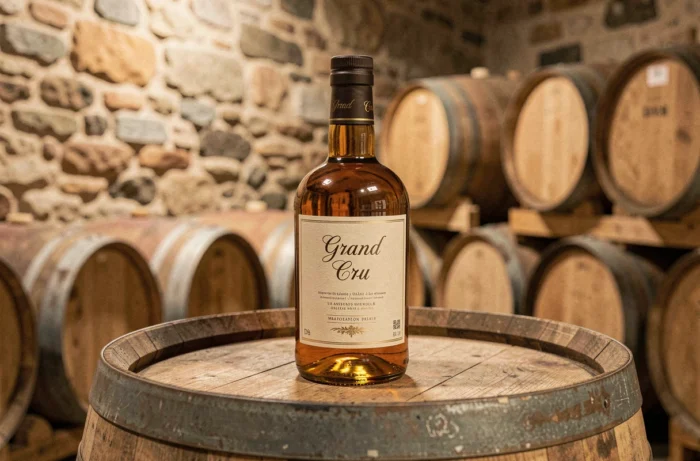
Fondaudège Grand Cru whisky makes a clear promise: a French single malt aged in Bordeaux oak casks and sold in supermarkets at a price that puts it up against blended Scotch whiskies and entry-level Japanese whiskies. To assess what this bottle is really worth, you need to compare like with like: price per litre, production method, flavour profile and traceability of origin.
Fondaudège Grand Cru versus entry-level single malts: comparison table
Fondaudège Grand Cru’s price point puts it in direct competition with bottles readily available in supermarkets. Here are the factors that help put it in context.
| Criterion | Fondaudège Grand Cru | Entry-level Scotch single malt | Typical Japanese blend |
|---|---|---|---|
| Claimed origin | France (barley, distillation, ageing) | Scotland (often from a single identified distillery) | Japan (blended, with varying distilleries) |
| Cask type | French oak (Quercus robur/petraea) | American oak or ex-bourbon, sometimes sherry | Various (bourbon, sherry, mizunara) |
| Distillation | Double, Charentais still | Double, copper pot still | Varies by blend |
| ABV | 40 % | 40 to 43 % | 40 to 43 % |
| Chill filtration | No | Often yes | Varies |
| Main distribution channel | Supermarkets | Supermarkets and specialist wine and spirits shops | Supermarkets and specialist wine and spirits shops |
Fondaudège’s decision not to chill-filter is a technical choice that preserves the distillate’s fatty compounds. For Scotch single malts sold at a similar price, chill filtration is common, resulting in a lighter mouthfeel.
One point is worth reading carefully: for a detailed review of Fondaudège Grand Cru whisky, the tasting notes highlight a short finish—a recurring observation in most reviews of this expression.

French whisky traceability and the GI proposal: what Fondaudège can prove today
Fondaudège claims an entirely French production chain, from barley to bottling. The brand belongs to Whiskies du Monde, a Bordeaux-based company listed as the distiller on the labels and in the World Whiskies Awards rankings. The name evokes Bordeaux, and the marketing emphasises terroir.
However, no geographical indication currently protects the designation “French whisky”. The proposed “Whisky de France” GI would set out specifications governing production and ageing in mainland France, as well as the use of French-grown grain. The application still has to go through the official recognition process, so these rules are not yet in force.
For Fondaudège, the stakes are tangible. Until the GI is established, the claimed origin rests on the brand’s own declaration, not on independent verification. Scotch competitors, by contrast, benefit from a strict regulatory framework requiring distillation and maturation in Scotland, with verifiable checks.
- The proposed French GI would require production and ageing in mainland France, with grain traceability.
- Fondaudège would need to ensure its expressions comply with the final specifications to claim this future GI.
- As things stand, consumers have no third-party label guaranteeing the whisky’s origin, unlike Scotch.
Fondaudège’s French identity is built on brand storytelling, not a binding regulatory framework. That is not necessarily a flaw, but it is a limitation to be aware of before buying.
Fondaudège Grand Cru’s flavour profile compared with whiskies at the same price
French oak (Quercus robur or Quercus petraea) releases more pronounced tannins and distinctive vanilla notes compared with American oak (Quercus alba). In Fondaudège Grand Cru, this translates into aromas of ripe pear, vanilla and sweet almond. On the palate, the texture is rounded and slightly honeyed, with a clear cereal note underneath.
Double distillation in a Charentais still—the type used for cognac—links this method to the traditions of south-western France rather than the Scottish tradition of copper pot stills. The result is a delicate distillate that is softer on the palate than a Scotch of the same age.
The main criticism remains Fondaudège Grand Cru’s short finish. Even at 40% ABV, an entry-level Scotch single malt generally has a more lingering finish. This brevity may disappoint Scotch drinkers, but it makes the bottle approachable for those discovering single malt whisky.
Who this bottle is really for
Fondaudège Grand Cru is not trying to compete with an 18-year-old Glenfiddich or a 12-year-old Yamazaki. Its natural home is the spirits aisle in supermarkets, alongside blends and entry-level single malts. Its strength is its accessibility in supermarkets, a channel where most French whiskies are still absent.
For curious drinkers who want to try a single malt without visiting a specialist shop, it delivers. For enthusiasts seeking complexity and a long finish, a comparison with Scotch or Japanese whiskies in the same price range does not favour Fondaudège.
Market context: where French whisky stands in terms of volume
According to IWSR analysis published in October 2026, global volume growth in 2025 came from Indian, Irish and other-origin whiskies, while Scotch, American and Japanese categories declined. The premium segment was the only price tier to record notable volume growth.
This context changes how the market should be viewed. Fondaudège is not up against giants in the midst of rapid expansion. It is entering a market where established origins are losing ground in volume and newer producers are gaining visibility. Its supermarket availability and accessible price are advantages in an environment where traditional producers are adjusting their stocks.
Fondaudège Grand Cru fills a specific niche: an accessible French single malt sold where consumers actually buy their spirits. Its main limitations—the short finish and the lack of a regulatory framework certifying its origin—will only be addressed over time, if the “Whisky de France” GI is approved and the brand complies with it. For now, the bottle is worth trying as a first introduction to French whisky, but not as a replacement for a benchmark Scotch in a collection.