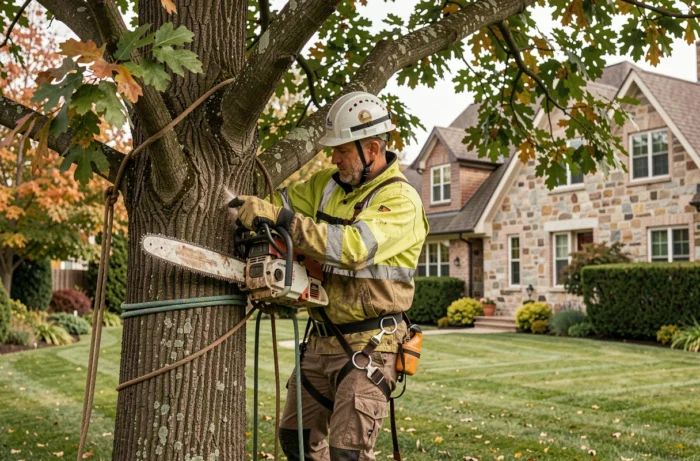
Several distinct businesses operate under the name Winterstein in France’s tree-pruning sector. Before requesting a quote, identifying the exact legal entity, its service area and its insurance coverage can help prevent confusion with real financial consequences. Here are the key points to understand so you can approach the process with confidence.
Multiple SIRET numbers under the same name: understanding the confusion around Winterstein Élagage
The name Winterstein is associated with sole traders and companies based in different departments. Listings exist in Villecresnes, Aix-en-Provence, Sotteville-sous-le-Val and Larnage, among other places. Each corresponds to a different SIRET number, meaning these are legally independent entities.
This has a direct consequence: signing a quote with one business does not bind another. If a dispute arises, only the company whose SIRET number appears on the document is liable. Checking this number in public databases such as Societe.com or Pappers is an essential step before making any commitment.
For a detailed checklist of the information to verify, the Winterstein Élagage company on Clic Garden offers a useful starting point for understanding the differences between these businesses.
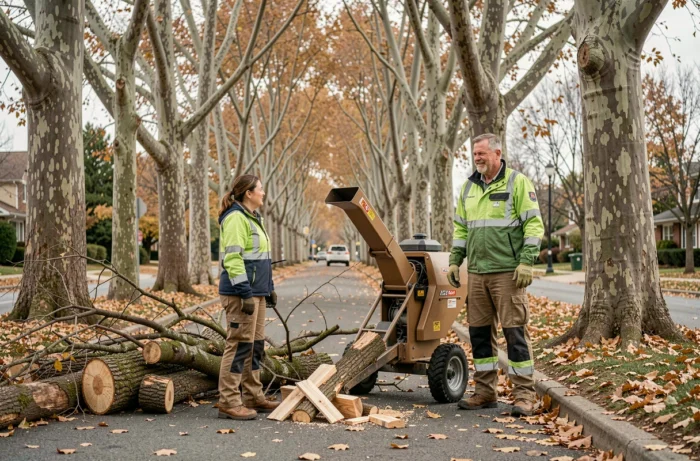
Insurance and qualifications for a tree surgeon: documents to request
Tree pruning involves working at height, handling chainsaws and sometimes carrying out work near power lines or buildings. If an accident occurs or a tree falls onto a neighbour’s fence, the property owner may be held liable if the contractor is not insured.
Ask for the following documents before work begins:
- Professional liability insurance certificate, covering damage caused to third parties (neighbours, passers-by and infrastructure) during the work.
- Decennial liability insurance certificate, if the work affects the structure of a building or other construction (for example, a retaining wall weakened by roots).
- Proof of arboriculture qualifications or training, confirming that the tree surgeon is familiar with pruning techniques that respect tree physiology.
Online directories and Google listings do not prove that these protections are in place. Only a document provided directly by the professional, showing a policy number and validity dates, serves as proof.
When to carry out the work and local regulations on tree pruning
Not all trees should be pruned at the same time. Deciduous species generally tolerate pruning better during dormancy, usually from late autumn to early spring. Pruning while sap is rising weakens the tree and encourages the growth of pathogenic fungi.
Regulations may impose additional requirements. Some municipalities require prior authorization to fell trees or carry out heavy pruning on protected trees, trees in conservation areas or trees listed in a local urban development plan. A professional tree surgeon will know these requirements and plan the work accordingly.
Trees near power lines
Work on a tree very close to cables is subject to strict rules. The network operator (Enedis for low- and medium-voltage lines) must be notified, and only authorized operators may work near live power lines. Raising this issue when requesting a quote helps avoid unpleasant surprises on the day of the work.
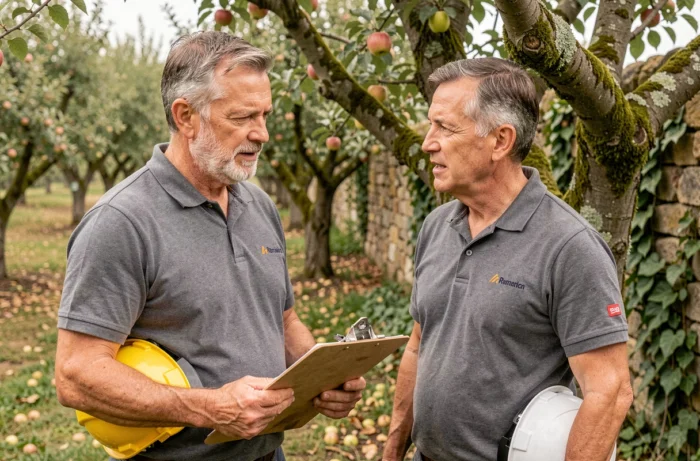
What a tree-pruning quote should include: details that protect the customer
A tree-pruning quote should be more than a single line showing the total price. To compare offers and protect yourself in case of a disagreement, make sure it includes the following details.
- A precise description of the work: number of trees, type of pruning (light, formative or heavy) and approximate cutting height.
- How green waste will be handled: chipped on site, removed or left for the property owner to deal with. This can account for a significant portion of the total cost.
- The company’s SIRET number and registered office address, so you can confirm that they match the business you contacted.
- The estimated duration of the work and site access requirements (machinery, cherry picker or climbing arborist).
A contractor who refuses to put these details in writing is a warning sign. Transparency about the exact scope of the work is a clear indicator of the company’s professionalism.
Tree-pruning costs: why prices vary so much
Prices depend on the tree’s height and accessibility, its species (a century-old oak requires different treatment from a hedge of thuja) and the techniques used. Using a cherry picker or a climbing arborist also affects the cost. Comparing three detailed quotes and checking that they cover the same scope of work is the most reliable way to assess whether a price is reasonable.
The lowest price is not always the best value. Poorly executed pruning weakens the tree and means the work has to be done again a few years later, effectively doubling the cost. It is better to invest in pruning suited to the tree’s biology than to pay twice to fix a botched job.
Before contacting a tree surgeon named Winterstein, check the SIRET number, request insurance certificates and read the quote carefully. These three steps can make the difference between a well-managed job and a potential dispute. The same precautions apply to any tree-pruning contractor, regardless of their local reputation.