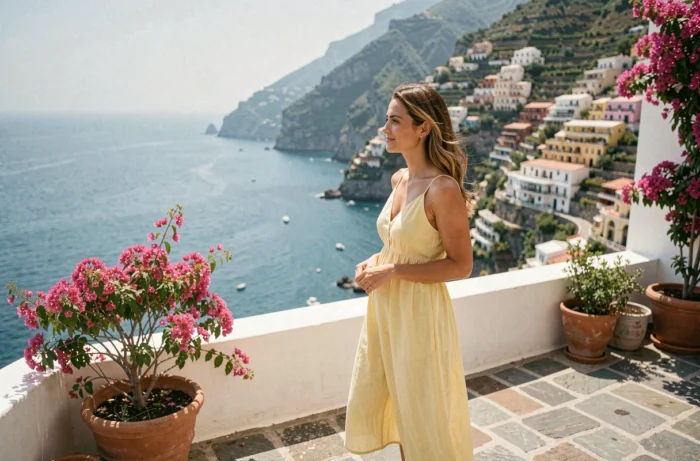
The Italian peninsula has one of Europe’s longest coastlines, with a wide variety of beach settings: gently sloping sandy seabeds along the Adriatic, rocky coves on the Tyrrhenian coast, and cool currents on the Ionian side. Choosing an Italian summer destination without considering these geomorphological features alongside the density of nearby heritage sites can leave you with a trip that falls short of expectations.
Geomorphological factors to consider when choosing a beach destination in Italy
The type of coastline shapes the swimming experience far more than the color of the water in photos. The sandy shores of Salento (Puglia) and Costa Rei (eastern Sardinia) are easy to access and well suited to families with children. The limestone cliffs of the Amalfi Coast and Cinque Terre require access by stairs, boat, or trail. This keeps visitor numbers down but makes getting around more complicated.
Water temperatures also vary by sea. The southern Adriatic reaches its warmest temperatures earlier than the Tyrrhenian Sea, making Salento suitable for swimming from mid-June, while some Ligurian coves remain cool until early July. Seagrass meadows, common in Sardinia, are a sign of clean water but may surprise swimmers who are unfamiliar with them.
We recommend weighing three factors before making your choice:
- The coastal terrain (sand, pebbles, or rocks) and how it affects accessibility, especially for children and people with reduced mobility.
- The system of beach concessions, which is currently undergoing regulatory changes in Italy and may affect the services available (sun loungers, umbrellas, showers) from one season or municipality to the next.
- The distance between the beach and the nearest significant heritage site: once the drive exceeds forty minutes, going back and forth between the sea and cultural attractions becomes an itinerary in itself, not a pleasure.
If you want to travel to Italy for a summer vacation that combines swimming and sightseeing, apply this filter before even consulting the travel guides.
Eastern Sicily: a wealth of heritage just steps from the sea
Eastern Sicily offers the peninsula’s best balance of beach and culture. Syracuse, Catania, and Taormina are home to Greek and Roman archaeological sites just minutes from beaches and accessible coves. Taormina’s ancient theater overlooks the bay, while in Syracuse, the island of Ortigia combines a Baroque historic center with waterfront spots for swimming.
The volcanic hinterland around Mount Etna adds a rare geological dimension. Lava-rich soils produce high-altitude vineyards (Nerello Mascalese), offering a cultural and culinary complement to a beach vacation without requiring a major detour.
The main concern is overcrowding in Taormina during peak season. Visiting in the first few weeks of June or in September makes it possible to explore the sites in more comfortable conditions. Travel-planning sources confirm that May–June and September offer milder temperatures for combining sightseeing and swimming, without the pressure of midsummer crowds.
Naples and the Gulf of Campania: rich heritage and islands within ferry reach
Naples is a hub for ferry trips to Capri, Ischia, and Procida, while its own urban heritage merits several days of exploration. The National Archaeological Museum, Herculaneum, and Pompeii form a collection of sites few Mediterranean regions can match for sheer density.
Ischia combines natural thermal springs with volcanic beaches, giving it a distinctive character compared with the more glamorous, rocky island of Capri. Smaller Procida has retained its authentic village feel, with colorful facades lining the harbor at Marina Corricella.
The Amalfi Coast, accessible from Salerno or Sorrento, has spectacular scenery but can be challenging to navigate. Its beaches are narrow and often lie below winding roads. This is not a classic destination for lounging on the beach; it is a landscape to explore, ideally by boat or along the coastal trails.
Plan ahead for summer access challenges
The Naples–Sorrento–Amalfi route experiences heavy traffic from mid-July to late August. Ferries to Capri sell out by midday. Booking crossings in advance and aiming for early departures can transform the experience.
Puglia and Sardinia: two distinct beach destinations not to be confused
Puglia and Sardinia regularly feature on lists of Italian summer destinations, but they cater to different expectations.
Salento (southern Puglia) offers flat coastlines, whitewashed villages (Ostuni, Locorotondo), outstanding rustic cuisine, and accessible sandy beaches. Its heritage is less concentrated than in Sicily or Campania, but the balance between beachside quality of life and the cost of a stay is among the best in Italy. Lecce’s Baroque architecture is the area’s main cultural highlight.
Sardinia, by contrast, stands out for its exceptional coastal scenery (Costa Smeralda in the northeast, Ogliastra in the east, and the beaches of Sinis in the west) and its distinctive Nuragic heritage, unlike anything else in the Mediterranean. However, archaeological sites are scattered across the island’s interior and require a car to reach.
- Puglia: accessible beaches, excellent food, Baroque heritage centered around Lecce, moderate costs.
- Sardinia: spectacular coastal scenery, scattered Nuragic heritage, more demanding logistics (a car is essential), higher costs in peak season.
- Both regions have crystal-clear water, but Sardinia’s seabeds (granite and seagrass) are better suited to snorkeling than Salento’s sandy seabeds.
Cinque Terre and Liguria: what to consider before booking
Cinque Terre draws visitors with its picture-perfect scenery, but the practicalities deserve a clear-eyed look. Access to the Via dell’Amore requires booking a time slot, and other park trails require a paid pass. Trains between the five villages—the only convenient way to get around—are very crowded in summer.
Beyond Cinque Terre, Liguria (Portofino, Sestri Levante, Camogli) offers less crowded alternatives, with maritime heritage and coves that make the detour worthwhile. Portofino remains expensive and busy, but nearby towns such as Santa Margherita Ligure and Rapallo retain a more local character.
For a trip that combines the sea and culture without logistical hassles, Liguria works better as a short stop on a northern Italy itinerary than as the main destination for a two-week stay.
Choosing a summer destination in Italy comes down to practical factors: coastline type, distance between the sea and heritage sites, time of year, and visitor numbers. Eastern Sicily and the Gulf of Naples offer the best balance of cultural attractions and beach access.
Puglia and Sardinia suit different kinds of travelers and are best not treated as interchangeable. Checking trail conditions, beach regulations, and booking slots before departure is the most useful way to turn an itinerary into a vacation you’ll truly enjoy.