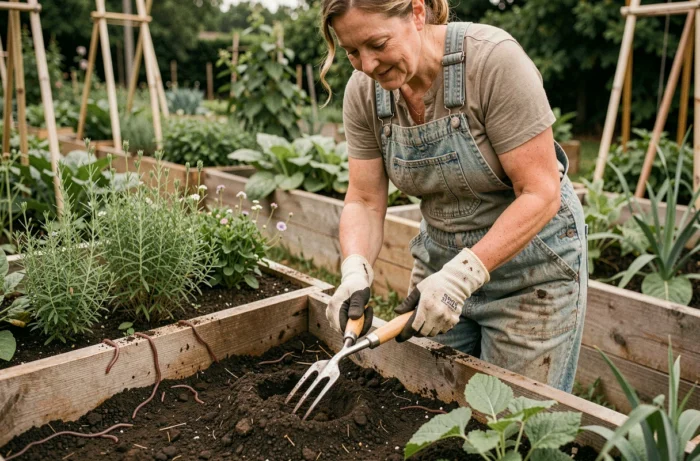
Compacted soil, no earthworms, tomato plants that fail to thrive: the problem rarely lies with the seeds. It comes from what is happening beneath the surface. The broadfork makes all the difference because it aerates the soil without turning it over, preserving the life within it. Here’s how to get the most out of this tool for a truly productive vegetable garden.
Why a broadfork doesn’t turn the soil (and why that matters)
Have you ever noticed how, after conventional digging, the soil forms a hard crust after the first rain? Turning the soil exposes deeper layers to the sun and air, destroying the aerobic microorganisms living near the surface and burying the anaerobic ones that have been brought up.
A broadfork works differently. Its tines penetrate the soil to a depth of around eight inches, then a backward levering motion lifts and cracks the soil without turning the layers over. Each soil layer stays in place, with its soil life intact. Earthworms, mycorrhizal fungi, and bacteria can continue their work of decomposition and soil formation.
One detail that’s often overlooked: reducing tillage doesn’t eliminate every challenge. Experience from conservation agriculture shows that weed or slug pressure can increase at the start of the transition. In a vegetable garden, this means that switching from a spade to a broadfork also requires adapting your mulching and crop rotation. The tool alone isn’t enough; the whole system needs rethinking.
Several detailed guides to different models and tine selection are available at grelinette-warrior.com, a good place to start before investing.
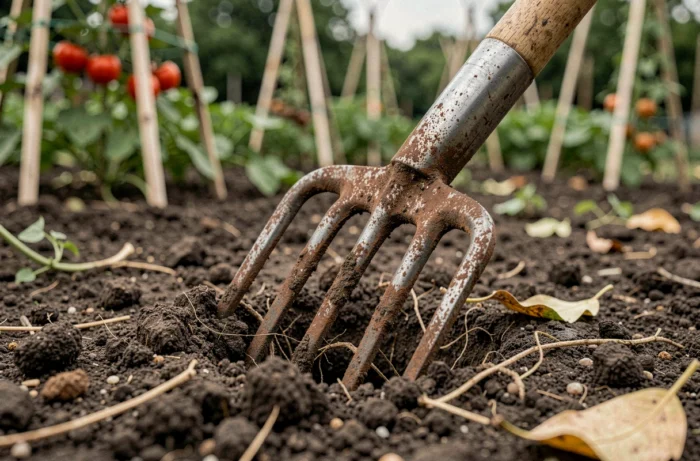
Choosing a broadfork for your garden’s soil type
Not all soils are worked the same way. The number of tines and the spacing between the handles can make a big difference to the effort required and the results.
Clay and compacted soil
Heavy soil offers more resistance to penetration. Choose a model with 3 or 4 tines to concentrate the force on fewer points. The wider-spaced tines break up clods more effectively without requiring excessive force on the handles.
Always work the soil when it’s slightly moist, never waterlogged. Waterlogged clay compacts even more under pressure. Conversely, soil as hard as stone prevents the tines from penetrating properly.
Sandy or silty soil
These lighter soils can be worked with 5-tine models, which cover a wider area. The time savings are significant on large beds. The physical effort remains moderate because the soil offers little resistance.
Watch out for silty soils, which can form a surface crust after heavy rain. Using a broadfork breaks up this crust and restores air and water movement deeper in the soil.
The right technique to protect your back and your soil
A broadfork is known for being ergonomic, but poor technique can cancel out that advantage. Follow these steps:
- Push the tines vertically into the soil with your foot, keeping your back straight, as you would with a regular spade. Let your body weight do the work, not your arms.
- Pull both handles toward you as you lean back slightly. This levering motion lifts the soil without straining your lower back, as long as you keep your arms slightly bent.
- Take a step back and repeat. Never lift the soil to throw it: the aim is to crack it, not turn it over.
Where you walk matters just as much as your technique. Always walk on the paths, never on the beds you’ve just aerated. A single step on freshly worked soil compacts the surface layer again.
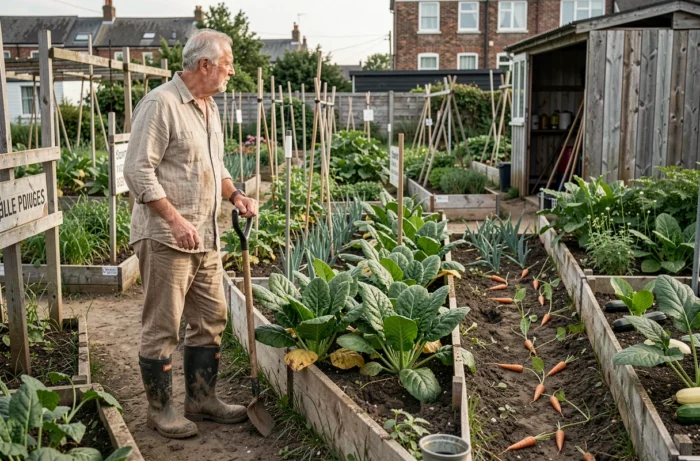
When to use a broadfork in the vegetable garden: two ideal times
When to use it depends on what you want to achieve. Two times of year are particularly suitable.
In autumn, after the last harvests, broadforking loosens the soil before winter. You can then cover the beds with organic mulch (fallen leaves, wood chips, or straw). Frost and winter biological activity improve the soil structure over several months without any further intervention.
In spring, a few weeks before sowing, a light second pass breaks up the crust that formed over winter and prepares an airy seedbed. Young plants’ roots establish more easily in cracked soil than in compacted ground.
Should you use a broadfork more often? Not really. Too many interventions, even gentle ones, disturb earthworm tunnels and fungal networks. Two passes a year are enough for most vegetable gardens.
Broadforking and permaculture: complementary soil practices, not substitutes
A broadfork fits into a natural gardening approach, but it’s only one part of the picture. Two complementary practices can multiply its benefits:
- Permanent mulching retains moisture and feeds soil life between passes. Without a cover, aerated soil dries out quickly in summer and compacts again in the rain.
- Cover crops (phacelia, mustard, clover) keep the soil occupied after harvests. Their roots naturally loosen deeper layers that the broadfork can’t reach.
- Crop rotation prevents nutrients from being depleted in one area. Alternating root vegetables and leafy vegetables distributes root activity at different depths.
Reducing tillage doesn’t mean doing nothing. The broadfork sits between intensive digging and direct seeding: it cracks the soil without disrupting it, making it suitable for most home vegetable gardens. The soil then does the work itself, as long as you leave its cover and inhabitants undisturbed.