
You measure liquid fertilizer with a cap marked in milliliters, fill a tank measured in liters, then come across a technical datasheet that uses cubic centimeters. Three units, the same volume—and yet the confusion regularly leads to dosing or ordering errors. This guide sets out the conversions once and for all, with practical reference points to help you avoid second-guessing yourself.
Why confusing cm³, mL and liters can cause real problems
In the kitchen, adding too much white vinegar is easy to fix. But when preparing a crop treatment or calculating the capacity of an industrial container, confusing cubic centimeters and milliliters with liters can throw off the entire process. The problem isn’t the formula (it’s simple), but the fact that each field uses whichever unit suits it without always explaining how the units relate.
Automotive technical datasheets express engine displacement in cm³. Medication instructions use mL. Agricultural tanks are labeled in liters. The same physical quantity—volume—is expressed using three different labels.
A liter-to-cm³ conversion chart lets you check an equivalence in seconds, but understanding the logic behind it means you won’t need to look it up every time.
Volume equivalents: liters, milliliters and cm³
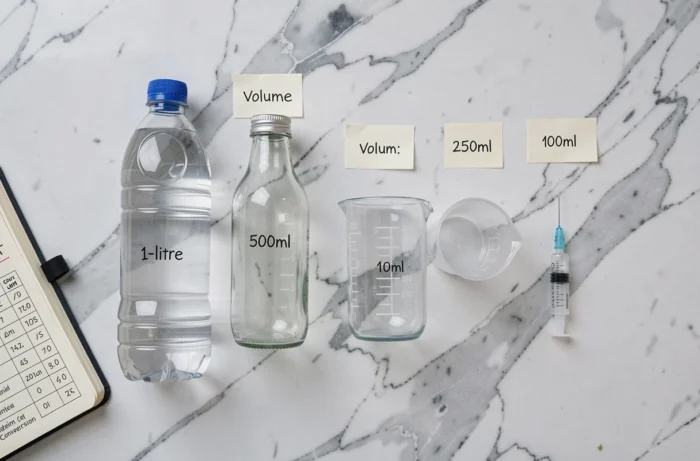
The basic relationship fits on one line: 1 liter is exactly 1,000 milliliters and 1,000 cm³. In other words, 1 mL and 1 cm³ refer to precisely the same volume. This is not an approximation; it follows from the very definition of the liter, which is equivalent to one cubic decimeter (dm³).

For larger volumes, remember that one cubic meter contains 1,000 liters. Here are the conversions that come in handy in everyday situations.
| Starting unit | Operation | Resulting unit |
|---|---|---|
| cm³ | Divide by 1,000 | Liter |
| Liter | Multiply by 1,000 | cm³ (or mL) |
| mL | Same value | cm³ |
| m³ | Multiply by 1,000 | Liter |
| Liter | Divide by 1,000 | m³ |
When you come across deciliters or centiliters, the same principle applies: move the decimal point. One deciliter is 100 mL, and one centiliter is 10 mL.
Convert volume without a calculator: the place-value chart method
The method taught in middle school works just as well at the kitchen table as it does in a workshop. Draw a chart with one column for each volume subunit.
Liter columns
From left to right: kiloliter (kL), hectoliter (hL), decaliter (daL), liter (L), deciliter (dL), centiliter (cL), milliliter (mL). Place one digit in each column, positioning the ones digit in the column for the starting unit. Fill any empty spaces with zeros.
Cubic meter columns
The cubic-unit chart follows the same logic, but each unit takes up three columns (because you’re moving from a linear dimension to a volume). From km³ to mm³, each step multiplies or divides by 1,000 rather than 10.
You don’t need to memorize both charts. The link between the two systems is the equivalence 1 L = 1 dm³ = 1,000 cm³. Once you’ve got that reference point, you can move between the charts without making a mistake.
Worked example
Let’s convert 2,500 cm³ to liters. Divide by 1,000: the result is 2.5 L. If you want the value in centiliters instead, multiply 2.5 L by 100 to get 250 cL. Using the place-value chart, put the 0 from 2,500 in the cm³ (or mL) column, then read the decimal point at the liter column.
Practical situations where converting liters to cm³ makes all the difference
Formulas alone aren’t always enough. Here are some situations where the unit used directly affects how you interpret the result.
- Engine displacement: an engine rated at 1,600 cm³ is equivalent to 1.6 L. On an order form or vehicle registration document, checking this equivalence helps you avoid comparing incompatible figures from two manufacturer datasheets.
- Laboratory or pharmacy dosing: syringes and pipettes are marked in mL. Since 1 mL = 1 cm³, reading instructions in cm³ and measuring in mL amounts to the same thing, with no calculation needed.
- Aquarium capacity: measure the internal dimensions in centimeters, multiply length by width by height, and you get a volume in cm³. Divide by 1,000 to find the number of liters of water needed.
- Large-scale cooking: when a recipe calls for 200 mL of cream and you’re cooking for fifty people, you quickly get to 10 L. Remembering to multiply or divide by 1,000 helps prevent errors in proportions.
The liter and the International System: a detail worth knowing
The liter is everywhere in everyday life, but it is not one of the base units of the International System of Units (SI). The SI coherent unit of volume is the cubic meter. The International Bureau of Weights and Measures permits the use of the liter alongside SI units, specifying that it is exactly equal to one cubic decimeter.
In practice, this distinction matters mainly in scientific or technical calculations where all quantities must be expressed in a consistent system of units. If you mix liters with meters and kilograms in the same formula, you risk being off by a factor of 1,000. The safest approach is to convert volumes to m³ before plugging them into a physics equation.
For household, commercial or culinary use, the liter and its subunits remain the easiest units to read. European Directive 98/6/EC also requires prices to be shown per unit of measurement, including per liter, so consumers can compare products sold in different quantities.
Three reference points are enough for most everyday volume conversions: 1 mL equals 1 cm³, 1 L equals 1,000 cm³, and 1 m³ equals 1,000 L. Everything else is just a matter of moving the decimal point.