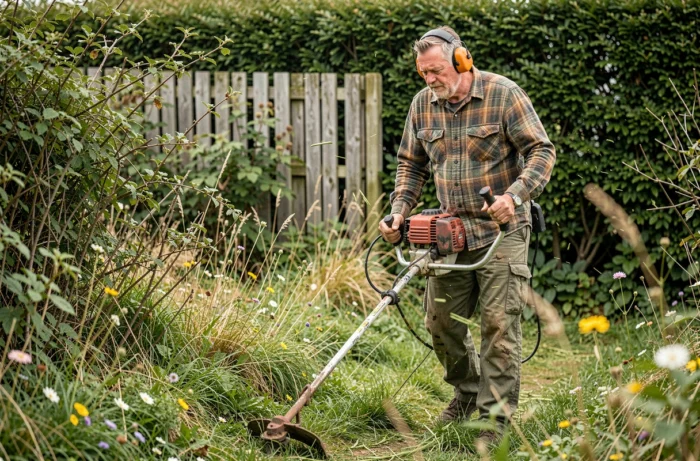
The brushcutter market covers a wide spectrum, from small electric trimmers to powerful gas machines capable of clearing thick brambles. In the face of this offering, the choice relies less on the brand and more on a series of parameters related to the terrain, vegetation, and local regulatory constraints. Before comparing models, it is essential to make the right diagnosis of what the garden truly requires.
Noise and local regulations: what conditions the choice before power
Most selection guides start with the engine type or the type of vegetation. In practice, a constraint often overlooked weighs heavily on the decision: the permitted hours for gardening equipment. These time slots depend on prefectural or municipal orders, and there is no uniform national rule.
In densely populated residential areas, a powerful but noisy gas model may become unusable for most of the week. Checking the applicable order with the town hall before purchase helps avoid a machine relegated to the back of the garage. A battery-powered brushcutter, significantly quieter, then offers more flexibility in terms of timing.
Plots located in fire risk areas add another dimension. Legal obligations for clearing sometimes require maintaining clear surroundings and access according to specific local rules. The official risk prevention service sheets or a visit to the town hall can provide information on the requirements applicable to one’s plot. Again, the expected result may lead to a tool that one might not have initially considered.
To compare the technical characteristics of different models and filter according to these criteria, a useful resource: https://www.ma-debroussailleuse.com.
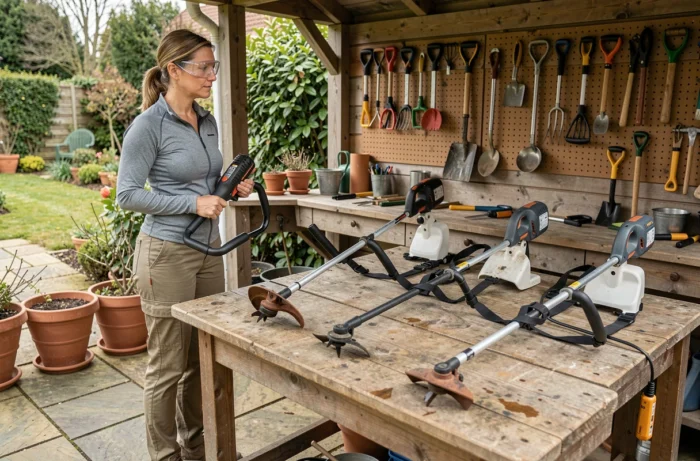
Gas, electric, or battery brushcutter: the limits of each motorization
The choice of motorization structures everything else. Each type has clear advantages but also gray areas that product sheets do not always mention.
Gas engine
This is the motorization that offers the greatest autonomy and the highest power. It is suitable for large areas, brambles established for several seasons, and woody undergrowth. The downside: higher weight, engine maintenance (oil change, spark plug, filter), high noise level, and pollutant emissions.
The gas option remains the only viable choice for large clearings in rugged terrain, where no electrical outlet is accessible and a battery’s autonomy is insufficient.
Wired electric motor
Light, quiet, and requiring no engine maintenance, the wired electric model is suitable for small gardens close to an outlet. Its limit is physical: the cord restricts the range of action and complicates work around trees or flower beds. For finishing work after mowing, on a modest area, it is a coherent choice.
Lithium-ion battery
Battery-powered brushcutters have progressed in recent years in power and autonomy. They are approaching entry-level gas models for common tasks. Their limit remains the actual autonomy under load, which decreases significantly on dense vegetation. Having a second battery then becomes almost necessary for a medium-sized garden.
Cutting head and blade: adapting the tool to the actual vegetation
The motorization does not determine everything. The cutting system determines what the brushcutter can actually handle. Confusing uses leads to poor results or premature wear.
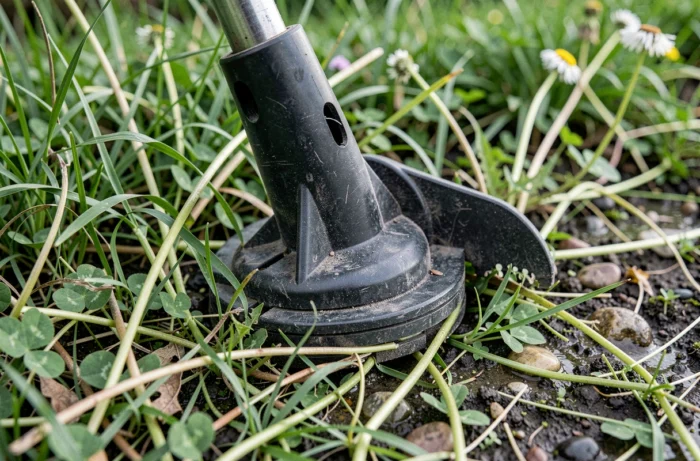
- The nylon line (round or square) is suitable for soft grasses, border finishing, and tall grasses. It wears out quickly on woody stems and does not cut thick brambles.
- The grass blade (three or four metal teeth) takes over on dense grasses and young shrub regrowth. It requires more engine power.
- The bramble blade or brush disc (often with multiple teeth) tackles established undergrowth, stems over one centimeter in diameter, and even small shrubs. Its use requires a suitable harness and personal protective equipment (visor, leg guards).
Some models accept several types of interchangeable cutting heads. Checking this compatibility before purchase avoids having to buy a new machine when the vegetation changes.
Ergonomics and safety: the criteria that matter after the third hour of use
The comfort of a brushcutter cannot be judged in a store for thirty seconds. It reveals itself after an hour of continuous work, arms raised, on sloping terrain.
The type of harness radically changes the fatigue experienced. A simple belt is sufficient for a lightweight trimmer. For a gas brushcutter or a blade model, a backpack harness distributing the weight across both shoulders and the hips becomes a real selection criterion, not a secondary accessory.
The handlebar also plays a role. Loop handles offer maneuverability in tight spaces. Bicycle handlebars (double grip) provide better lateral control on large flat surfaces. The choice depends more on the terrain configuration than on personal preference.
On the safety side, personal protective equipment is not optional. Visor or safety glasses, earplugs (especially with a gas engine), anti-vibration gloves, and reinforced pants are the minimum. Flying stones and debris are the leading cause of injury during brush clearing.
Regulatory clearing: do not confuse power with expected results
A point often misunderstood: regulatory clearing, in areas subject to fire defense obligations, does not necessarily mean clearing everything. Depending on the case, it involves pruning low branches, removing dry vegetation on the ground, or maintaining spacing between trees.
This nuance has a direct impact on the equipment. An overly powerful brush disc is not always the appropriate response. Sometimes, a robust nylon line combined with a strong pruner is sufficient and better preserves the vegetation one wishes to keep.
Before investing, checking the status of one’s plot with the town hall or through risk prevention services remains the most reliable approach. The right tool depends on the expected result, not the maximum available power.