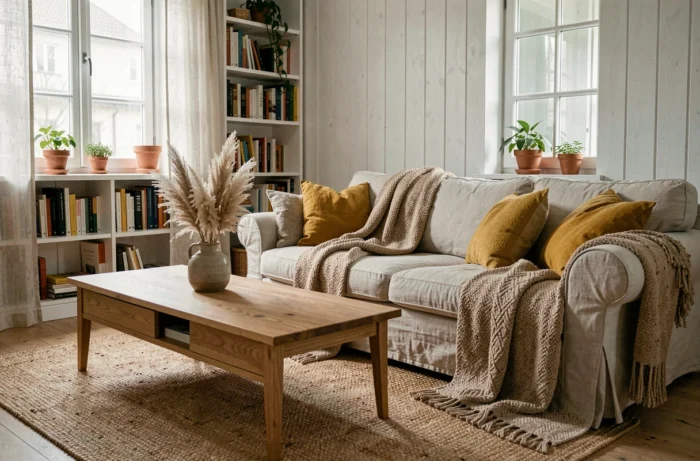
A tired sofa, slightly cold white walls, a room that lacks personality: the usual response is to open a catalogue and order new furniture. Yet the warmth of an interior depends less on the furniture itself than on how you work with the light, materials and existing space. A few targeted changes are often enough to transform a home without spending much.
Make your home feel warm without buying new furniture
Have you ever noticed that the same living room can feel chilly in the morning and welcoming in the evening, simply because a table lamp is on? This contrast illustrates a useful principle: a room’s warmth depends more on lighting and textures than on furniture.
Before replacing anything, start with what you already own. Drape a wool throw over an armchair, move a rug from a bedroom into the living room, or switch cushion covers with the seasons. These cost-free touches can instantly change how a space feels.
Reuse can go even further when you take it seriously. Second-hand furniture, found at flea markets or through specialist organisations, adds character that mass-produced new pieces struggle to replicate. An old solid-wood chest of drawers, sanded and waxed, can become a focal point in an entryway or living room.
Specialist reuse organisations make it possible to check the origin and condition of pieces, making purchases more secure than through a traditional flea-market channel. You can find more ideas on this topic in the home section of Angie Sweet Home, which explores different approaches to interior design.
Colours and natural light: test before you paint
Choosing a wall colour is one of the most powerful decorating tools, but also one of the most frequently misused. A warm ochre on a colour chart can turn dull yellow once applied to a north-facing wall. Why? Because the colour you see depends directly on the home’s actual lighting.
The reliable approach is to apply a paint sample (a rectangle at least thirty centimetres across) to the wall you have in mind, then look at it at three different times: in the morning, early afternoon and evening under artificial light. Test two or three different spots in the same room, since a corner near the window and a recess won’t receive the same amount of light.
Three colour families that warm up a space
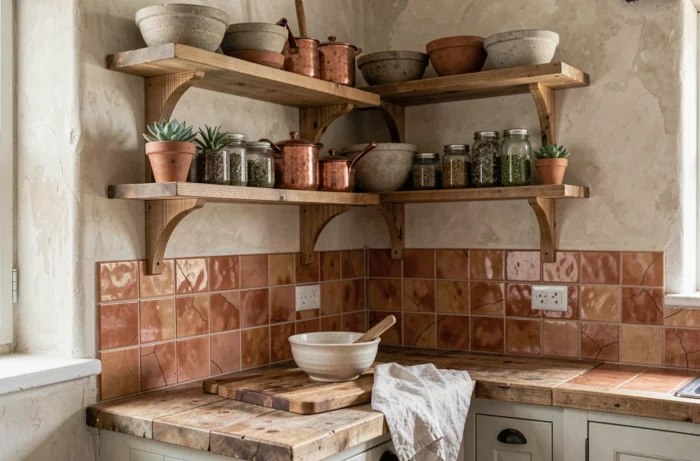
- Earthy tones (terracotta, ochre, sand) work well in west- or south-facing living spaces, where the evening light enhances their warm pigments.
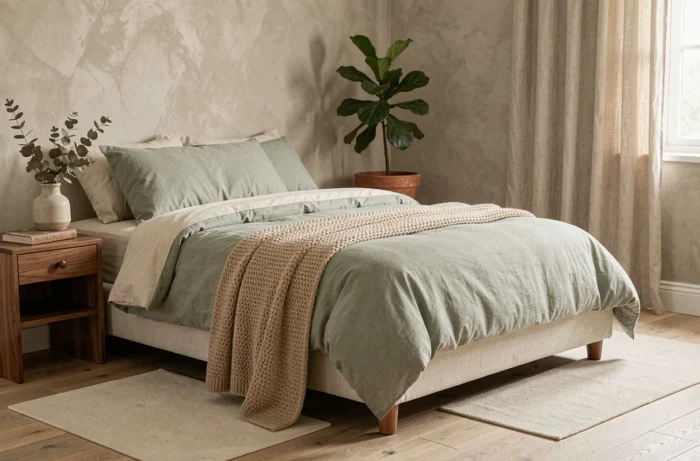
- Deep greens (sage, olive) create a cosy feel in a living room or bedroom, even with little natural light, as long as you pair them with light materials such as linen or pale wood.
- Off-whites with pink or yellow undertones are a better choice than pure white, which tends to look cold in homes with little natural light.
Often, painting just one wall in a bold colour is enough. Painting all four walls a dark shade in a small room may make it feel darker rather than warmer.
Flexible layouts for rooms that serve different purposes
A home rarely functions the same way on Monday morning as it does on Sunday evening. The same coffee table might serve as a desk during remote work, a play surface for the children, and then a dining table for four. Modular furniture avoids the need for extra pieces and frees up space.
An extendable table, for example, can go from seating two to six without taking up the space of a family-sized table all the time. Reconfigurable storage (shelving with compartments, stackable cubes) adapts to changing needs without requiring any building work.
Lightweight partitions to divide a space without building
When a large open-plan space lacks privacy, a movable partition or wooden screen creates a visual divide without blocking the light. Easy to move, this type of divider lets you define a home office or sleeping area in a studio apartment or an overly spacious living room.
Not sure whether to choose a heavy curtain or a wooden screen? A curtain absorbs sound and adds a cosy layer of fabric. A wooden screen defines the space more clearly and can also hold plants or small decorative objects.
A cosy atmosphere and thermal comfort are two different things
Filling a living room with throws and candles can create a visually cosy feel, but a truly comfortable home also needs to be properly insulated. Cosy textiles can’t make up for a draught under the door or a single-glazed window that lets heat escape.
Before investing in decor, check a few practical details:
- Are the window seals still flexible and airtight? Worn seals cost just a few euros to replace and can significantly reduce heat loss.
- Is a draught coming in under the door? A draught excluder or brush door seal will solve the problem straight away.
- Are the curtains thick enough? As well as adding a decorative touch, lined curtains provide a useful thermal barrier in front of a poorly insulated window.
Addressing these details improves everyday comfort and gives your decorating choices real purpose: a throw in a well-heated room invites you to settle in; in a freezing room, it’s compensating for a problem.
The warm interior you’re looking for comes from combining materials, light and genuine comfort. Changing the cushion covers, testing a paint sample on the right wall, moving a lamp from a dark corner to the coffee table: these small changes, repeated room by room, transform a home far more reliably than an impulsive furniture purchase.