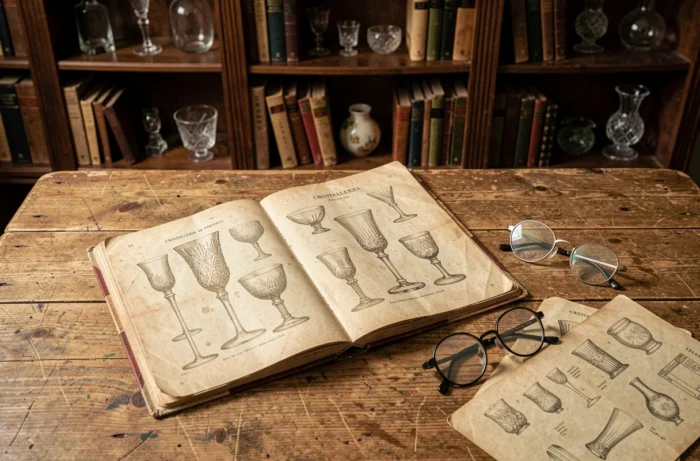
A colored glass found at a flea market, an engraved bowl discovered in a family buffet: many antique glass or crystal pieces come from the Portieux glassworks without their owner knowing. The catalog of this Vosges-based manufacturer, active since the early 18th century, has included several thousand references. Understanding how this catalog works and where to consult it changes the game for identifying, authenticating, and valuing these objects.
Portieux Crystal: A Label Covering Different Compositions
You may have noticed that an antique glass can sound clear like crystal without actually being it? The term “crystal” adheres to a defined standard. It refers to glass containing a minimum percentage of lead, which gives it its characteristic brilliance and sound.
The Portieux glassworks worked with superior crystal containing over 24% lead. This percentage distinguishes it from other manufacturers like Baccarat, whose crystal reaches 31% lead oxide. For a collector, this difference is not trivial: it affects the weight in hand, the sparkle, and the light refraction of each piece.
Before relying on the visual appearance or sound of an object to link it to the Portieux catalog, it is essential to keep in mind that brilliance alone does not prove the composition. Cross-referencing observations with the catalog plates remains the most reliable method to confirm an attribution.
Collectors looking to explore the Portieux glassworks catalog find a solid starting point to connect a piece to its original model.

Identifying a Portieux Piece Using Historical Catalogs
The 1914 catalog, partially digitized, is one of the most frequently used reference documents. It is divided into several thematic sections: table glassware, church articles, pieces for watchmakers, decorative objects. Each section presents illustrated plates with shapes, dimensions, and model names.
Iconic Models to Spot
Among the most sought-after series, the George Sand model regularly appears on the second-hand market. Champagne bowls, water jugs, pitchers: this range is recognized by its simple lines and balanced proportions.
The Venetian shape, with its characteristic hollow foot, also attracts enthusiasts. The Sphinx box, made of molded crystal, is one of the rarest curiosity pieces. Each of these models is listed in the catalog plates with a specific reference number.
Cross-Referencing Sources for Reliable Identification
Have you found a glass that resembles a plate from the catalog? That’s not enough to conclude. Here are the elements to check:
- Does the overall shape (foot, stem, bowl) exactly match the plate, including its proportions?
- Is the type of decoration (engraving, gilding, molding) consistent with the technique used by Portieux at the presumed time of manufacture?
- The absence of a mark does not mean the piece is not authentic: many older productions were not systematically marked.
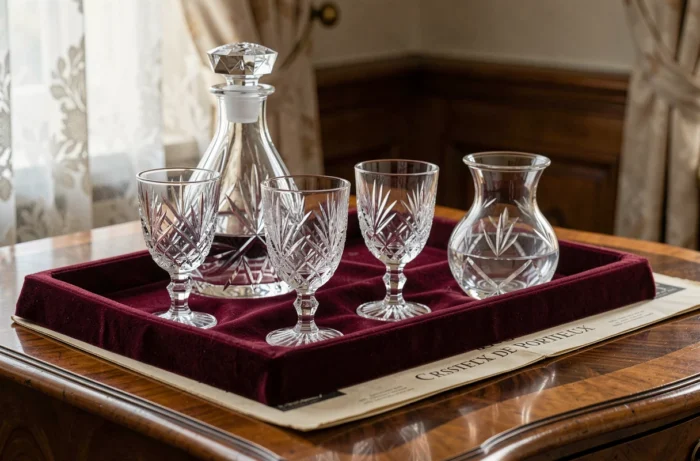
Digitized Archives and Limitations of Online Resources
The catalogs available online represent only a fraction of existing documents. The departmental archives specify that their online inventories do not cover all resources available in the reading room. New uploads are added as classifications progress.
For a collector, this practically means that the absence of a model online does not prove its non-existence. If a piece does not match any digitized plate, a search in physical archives (notably in the Vosges) may reveal unpublished plates or additional commercial documents.
Collaborative platforms like Pinterest also aggregate photos of identified Portieux pieces by collectors. These resources remain useful for visual comparison, but they do not replace period catalogs in terms of reliability.
Daily Use or Preservation: What Composition Changes
Collecting lead crystal pieces raises a practical question that many enthusiasts overlook. Prolonged contact between alcohol and lead crystal can lead to lead migration into the liquid. Therefore, storing wine or a spirit for several days in an antique carafe is not trivial.
On the other hand, occasional use (serving a glass during a meal, for example) does not pose the same problem. This distinction between prolonged storage and brief contact allows one to use Portieux pieces daily without condemning them to remain behind a display case, provided a few precautions are followed:
- Do not leave an acidic or alcoholic liquid in a lead crystal carafe for more than a few hours.
- Reserve antique carafes for decoration or occasional serving.
- For intensive daily use, prefer ordinary glass pieces from the same manufacturer, also present in the Portieux catalogs.
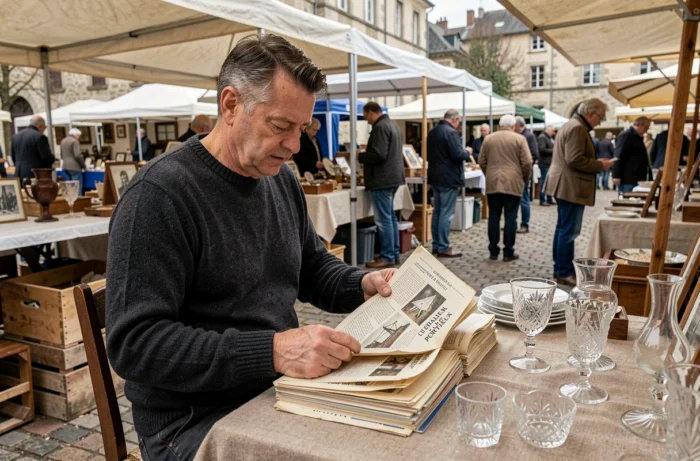
Estimating the Value of a Portieux Piece Accurately
The market for Portieux pieces is dispersed. No centralized aggregator compiles all sales. Prices vary according to the rarity of the model, its condition, the presence or absence of original gilding, and current demand.
One detail often changes the game: pieces sold in lots are negotiated at a unit price much lower than an isolated piece in perfect condition. A complete set of George Sand glasses will have more value than the same glasses sold individually, even if the total price seems higher.
Specialized websites in French glassworks and antique dealers who explicitly reference Portieux in their catalog offer the most coherent estimates. Comparing several sources before buying or selling remains the best protection against haphazard attributions and fanciful prices.
The Portieux glassworks permanently closed its doors in 2021, making each authentic piece a little rarer each year. For enthusiasts, learning to read period catalogs is not a luxury for scholars; it is the most concrete tool for distinguishing a find from a mere imitation.