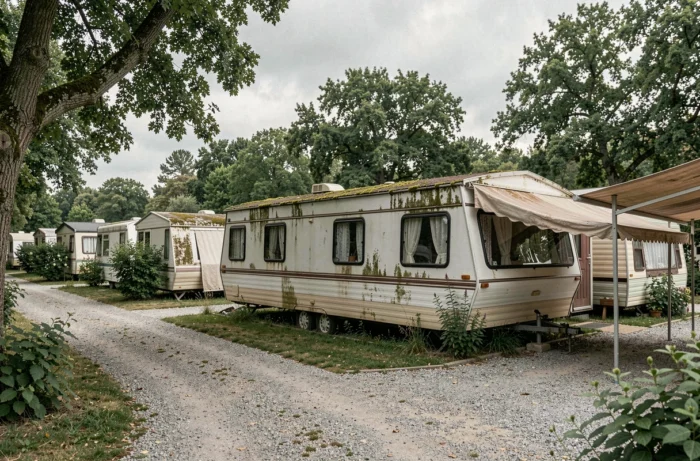
A mobile home that has been sited on a campsite pitch for more than twenty years is subject to a specific legal framework, distinct from that governing conventional real estate. Its classification as a leisure mobile residence (RML) under the French Urban Planning Code determines all of the owner’s rights and obligations, including when the unit reaches an age at which the site operator may require it to be removed.
Legal status of an older mobile home and age-limit clauses in the pitch rental agreement
A mobile home remains movable property, even after decades of use. It confers no ownership rights over the land, and its continued presence on the pitch depends entirely on the rental agreement signed with the campsite operator.
Most agreements include a wear-and-tear or age-limit clause, generally setting the limit at between fifteen and twenty years. This clause allows the operator to refuse to renew the pitch rental agreement once the limit has been reached. The decision is not a commercial whim: it is based on the site’s operating standards and the requirement to maintain a consistent fleet in terms of safety and appearance.
In practice, the owner receives notice, with the notice period specified in the agreement. If there is no explicit clause, the operator must still allow a reasonable period before requesting removal. The law on mobile homes over 20 years old governs these situations and sets out the implications for the owners concerned.
One point that is often overlooked: refusal to renew does not entitle the owner to any eviction compensation, unlike a commercial lease. The owner alone bears the transport costs and, where applicable, the cost of dismantling.

Mobile home dismantling requirements and recycling channels
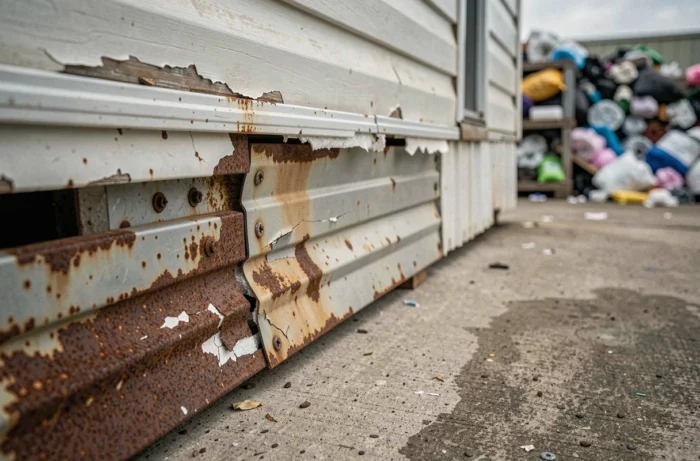
Removing a dilapidated mobile home from a site involves more than simply transporting it away. Its composite structure (steel chassis, sandwich panels, insulation, PVC or aluminium joinery, electrical wiring) requires materials to be separated—a process that conventional waste centres do not handle.
Typical composition and sorting requirements
A mobile home at the end of its useful life contains several material types, and separating them determines the recovery rate:
- Galvanised steel chassis and longitudinal beams, which can be recycled as scrap metal once non-metallic components have been removed.
- Wall and roof panels made of particleboard, sometimes treated, combined with expanded polystyrene or glass wool, which must be sent to separate waste streams (wood for energy recovery and insulation waste).
- Interior fittings (plumbing, electrical equipment, joinery) that require manual dismantling before shredding or reuse.
The recovery rate depends directly on the quality of the initial dismantling. Shredding everything together without sorting first sends most of the material to landfill, contrary to the regulatory waste-treatment hierarchy.
Specialist operators and preliminary assessment
Dismantling companies now offer a complete service: transport from the campsite, selective dismantling at a dedicated site, and routing each waste stream to the appropriate facility. Before any work begins, a waste assessment identifies the materials present and any potential pollutants (asbestos in older models, lead in some paints).
Dismantling costs vary considerably depending on how accessible the mobile home is, the distance to the treatment centre and the presence of hazardous substances. We have found that the lack of a dedicated EPR (extended producer responsibility) scheme for leisure mobile residences leaves the entire financial burden with the last owner.
Alternatives to demolishing a mobile home over 20 years old
Dismantling is not the only option. Several alternatives are worth considering before starting demolition work.
Private resale is still possible, even for an older model, provided it is in reasonable overall condition and a campsite is willing to accept it. Some more family-oriented or community-run sites allow older units, subject to a technical inspection (watertightness, gas installation, electrical system).
Donating it to an organisation is another option. Emergency accommodation providers or farms sometimes take mobile homes for temporary use, avoiding disposal as waste.
A third option is a major renovation. Replacing the insulation, bringing the electrical system up to current standards and replacing the windows and doors can extend the unit’s life by around ten years. The financial case only makes sense if the pitch rental agreement is renewed and the cost of the work is lower than the property’s residual value.
Local regulations and owner liability if a mobile home is abandoned
Leaving a mobile home abandoned on a pitch after the agreement has expired exposes the owner to penalties. The campsite operator may charge for unauthorised occupation and then arrange for the unit to be removed at the defaulting owner’s expense after a formal notice has gone unanswered.
Beyond the contractual dispute, abandoning a mobile home on a site constitutes illegal waste dumping under the French Environmental Code. The local authority may bring legal proceedings, and any applicable fines are added to the removal costs.
In addition, local urban planning schemes (PLUs) in some municipalities impose specific requirements on the maximum age of mobile residences permitted in camping zones. Checking the zoning regulations before buying a used unit can prevent the problem of ending up with a mobile home that cannot legally be sited.
The planned removal of the oldest mobile homes raises a nationwide waste-management issue, as there is no structured framework comparable to the one for end-of-life vehicles. As long as dismantling relies on private initiatives, with no regulatory collection requirement, the owner remains the final link in the chain and is responsible for funding and arranging the removal.