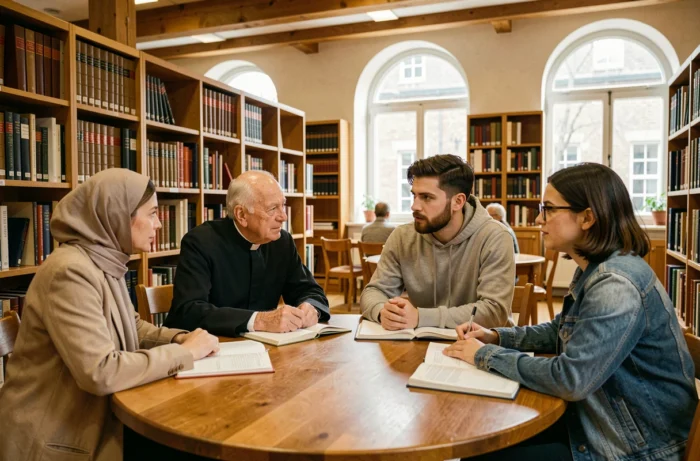
The Courtyard of the Gentiles refers both to a historic area of the Temple in Jerusalem and to a contemporary initiative launched by the Vatican. In ancient times, the space welcomed those who, without belonging to the Jewish people, wished to draw closer to the sacred. The modern initiative takes up this idea: creating a setting where believers and non-believers can discuss fundamental questions without requiring any prior commitment.
Interconvictional dialogue: what sets the Courtyard of the Gentiles apart from other initiatives
Several organizations arrange meetings between religious traditions. The Courtyard of the Gentiles stands out by explicitly including atheists, agnostics and humanists in the dialogue process. Most interfaith forums bring together representatives of established faiths. Here, having no religious belief is a dialogue position in its own right.
Recent interconvictional gatherings have seen growing participation from atheists and humanists alongside religious leaders. The Courtyard of the Gentiles builds on this momentum by structuring it as a dedicated program affiliated with the Pontifical Council for Culture.
| Criterion | Traditional interfaith forums | Courtyard of the Gentiles |
|---|---|---|
| Participants | Leaders of religious faiths | Believers, atheists, agnostics, humanists |
| Main objective | Doctrinal rapprochement or cooperation between religions | Discussion of shared existential questions |
| Institutional framework | Varies (UN, regional organizations, dioceses) | Pontifical Council for Culture (Vatican) |
| Local follow-up | Rare, often limited to joint statements | Intended, but varies among host cities |
Information about events and topics discussed is documented at https://www.parvisdesgentils.fr, which chronicles events held in different cities.
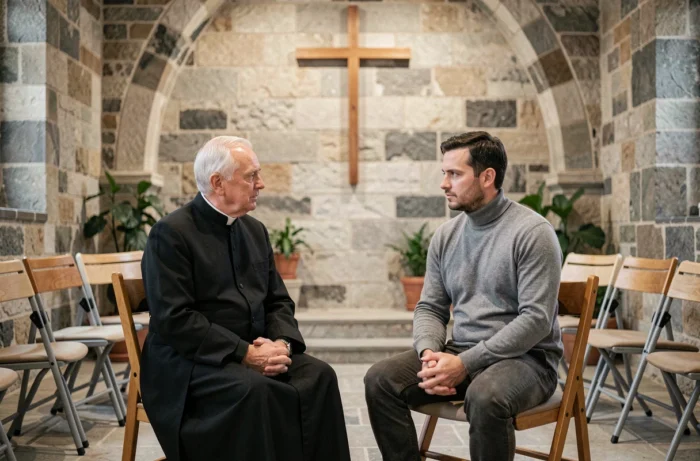
Mutual listening, practical cooperation and doctrinal boundaries
One point of tension runs through every effort to foster dialogue between different convictions: cooperation does not mean treating another person’s beliefs as equivalent to one’s own. Some theologians emphasize that a dialogue event is not a doctrinal statement.
This distinction helps explain the Courtyard of the Gentiles. The initiative does not seek to produce religious consensus. It aims to foster three distinct levels:
- Mutual listening, where each participant explains their perspective without trying to convert or refute the other
- Practical cooperation on shared concerns (peace, social justice, education, neighborhood solidarity)
- Acceptance of doctrinal disagreements as a reality that does not prevent people from working together
This three-part framework avoids confusing dialogue with relativism. A believer retains their convictions. An atheist does not claim to believe in transcendence. Common ground is built around concrete social concerns, not theological alignment.
Local projects after the event: does the Courtyard of the Gentiles turn dialogue into lasting action?
The main challenge for this kind of initiative is sustaining its impact. A one-off event, even a successful one, does not automatically produce long-term results. The most revealing way to assess the Courtyard of the Gentiles is to look at what happens after the conferences.
A recent article on the spirit of Assisi highlights the growing importance of educational initiatives and neighborhood solidarity as practical extensions of interconvictional dialogue. Local projects sometimes emerge from these gatherings: shared reading groups, joint charitable activities, and school workshops bringing together believing and non-believing families.
What hinders ongoing dialogue
The comparison table above notes that local follow-up is “uneven across host cities.” Several factors explain this disparity. The first is structural: once an event ends, no institutional mechanism guarantees that discussions will continue. Follow-up depends on local stakeholders, including parishes, secular associations and universities.
The second factor is cultural. In some cities, a tradition of interconvictional dialogue predates the Courtyard of the Gentiles. The event then amplifies an existing momentum. In other contexts, it remains an isolated occasion, with no roots in the local community.
What helps turn dialogue into joint projects
Events that produce lasting results share a few characteristics:
- Involvement of non-religious stakeholders from the planning stage (universities, cultural centers, community education organizations)
- A theme rooted in a specific local concern rather than an abstract philosophical question
- A follow-up schedule with meetings planned after the main event
Dialogue lasts when it is built around a shared, concrete project. Without an identified common goal, initial goodwill fades within a few weeks.
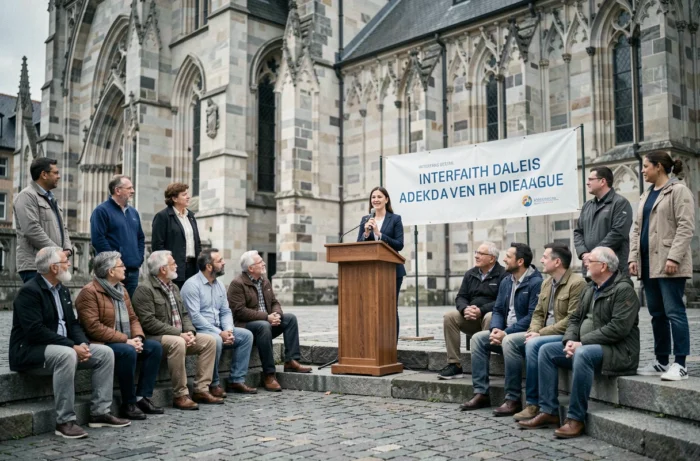
Peace and social issues: common ground for believers and non-believers
The Catholic Church’s recent synodal approach emphasizes peace and social issues as natural points of convergence for people with different convictions. This direction aligns with the Courtyard of the Gentiles’ approach: questions of justice, peace and solidarity require no theological prerequisites.
Recent interconvictional statements confirm this trend. Leaders from different religious traditions are calling for dialogue grounded in joint action, showing that social issues offer a space where cooperation can come before doctrinal debate.
The Courtyard of the Gentiles does not resolve the tension between listening and disagreement. It makes that tension visible and gives it structure. Its value is measured less by the conferences it organizes than by the local projects that outlast them. Dialogue continues in cities where local stakeholders, believers and non-believers alike, choose to work together on a specific issue long after the cameras have stopped rolling.